Date:2026-01-07 Source: Huaxin Anti Counterfeiting
The establishment of brand reputation is not an overnight process, but it can be instantly damaged by counterfeit and substandard products.
How to build a solid brand defense line has become a core issue for enterprises to protect their core assets and safeguard consumers' rights and
interests. As a national-level dual high-tech enterprise with a 17-year history in the field of anti-counterfeiting, Shenzhen Huaxin Anti-counterfeiting
Technology Co., Ltd. accurately grasps the industry demands and has launched variable code anti-counterfeiting labels and multi-layer composite
anti-counterfeiting labels. The former breaks the "one code for multiple uses" counterfeiting predicament with its dynamic encryption feature, while
the latter raises the imitation threshold through multi-dimensional protection. Both of them, with their outstanding anti-counterfeiting performance,
provide comprehensive protection for global brands.
I. Variable Code Anti-counterfeiting Label: Double-layer Anti-counterfeiting
The variable code label is an intelligent anti-counterfeiting label based on variable data technology. Its core feature is to assign a unique, traceable
dynamic code to each product through the "one item, one code" mechanism. Compared with traditional fixed code labels, the "dynamic nature" of the
variable code label is its core advantage - the code is bound to the product information and can be updated in real time through the system, completely eliminating copying and secondary use, providing a full-chain protection for brand enterprises from production to consumption.
The essence of the variable code label is "data as anti-counterfeiting". Through variable data printing technology (such as UV printing, digital printing),
each label's code contains a unique identifier (such as product ID, production timestamp), and is linked in real time with the enterprise's back-end
database. Consumers can scan the label through the official platform, and the system can quickly verify the authenticity of the code and provide
product information; at the same time, the system will automatically record the verification time and device information. If the same code is scanned
repeatedly, the system will prompt "invalid", preventing the label from being copied or counterfeiting, effectively curbing counterfeiting behavior at its
source.
Technical principle
Dynamic encryption algorithm:
Using asymmetric encryption technology, the product information and dynamic parameters such as time stamps and geographical identifiers are
bound to generate a unique encrypted string. When consumers scan and verify through the official platform, the system decrypts and returns the
verification result in real time, and updates the code library data to make the old codes invalid.
Dual verification mechanism:
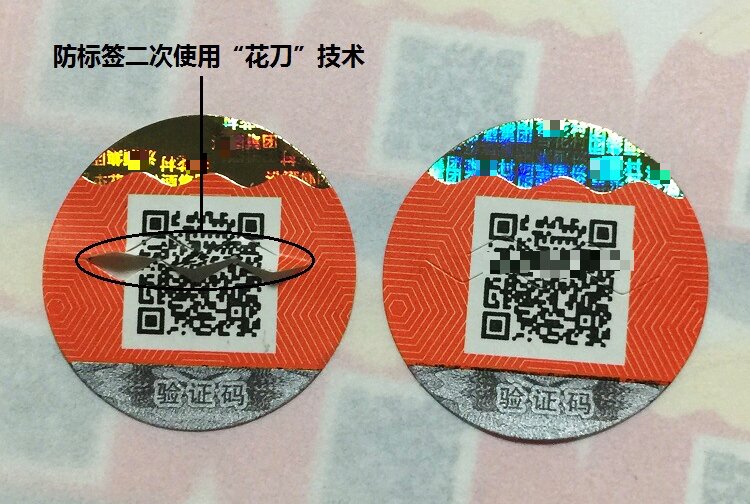
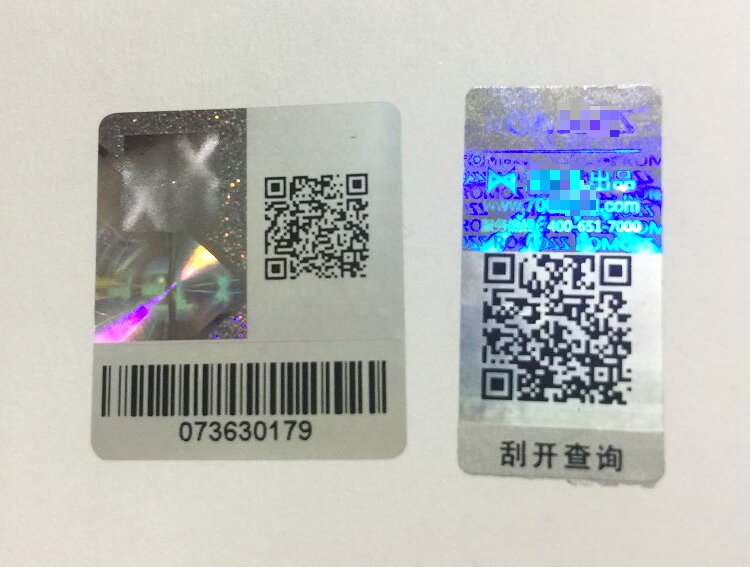
The surface of the label is printed with the visible code (for consumers' initial verification), and the bottom is embedded with the hidden code
(which needs to be uncovered and scanned), with the information of the visible and hidden codes mutually verifying each other. Even if the imitator
copies the surface visible code, due to the lack of the underlying dynamic key support, they still cannot pass the system verification, effectively
avoiding the loopholes in the single verification stage.
II. Multi-layer Anti-counterfeiting Composite Label
The multi-layer anti-counterfeiting composite label integrates physical structure and information technology to form a three-in-one protection
system of "physical anti-counterfeiting + digital verification + material protection".
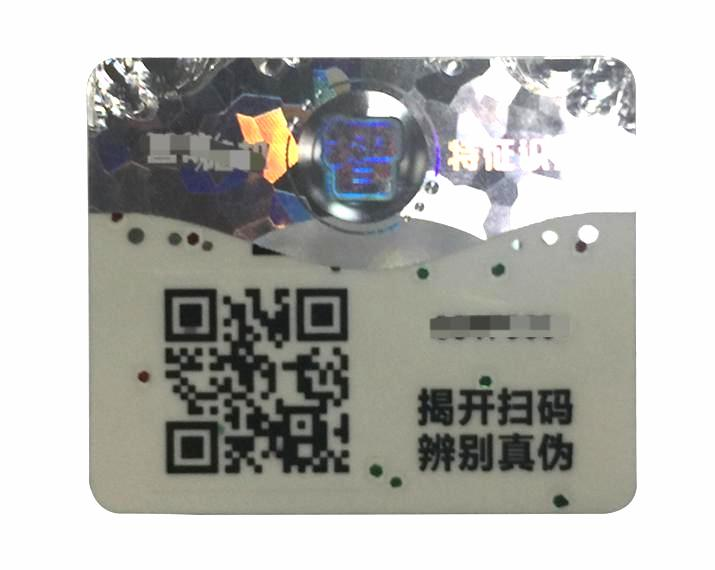
Two-layer structure design:
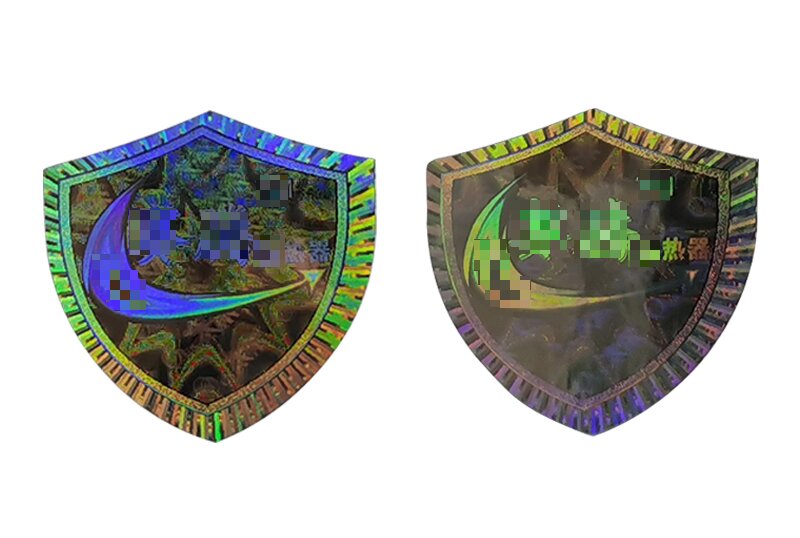
Top layer: The top layer is printed with brand logos and clear code QR codes using laser holographic laser technology, presenting a unique dynamic
visual effect. Ordinary printing techniques are difficult to replicate.
Bottom layer: Embedded encryption codes, microtexts, and special inks (such as temperature-sensitive and fluorescent ones) are included. After peeling
off the top layer, the bottom layer information is revealed, and the label will automatically leave "VOID" and other anti-counterfeiting marks to
ensure non-reusability.
Some labels adopt a "three-layer composite" structure:
The first layer: Laser holographic film, providing visual anti-counterfeiting;
The second layer: Printed with variable QR codes and digital watermarks;
The third layer: Special substrates (such as fragile paper or PET), enhancing tear resistance.
Advantages of integrated functionality:
The composite label can simultaneously carry anti-counterfeiting, traceability, and marketing functions. When consumers scan the code to verify
authenticity, they can simultaneously query the product production batch, and can directly participate in marketing interactions such as brand point
redemption and exclusive activities, effectively shortening the distance between the brand and consumers and achieving deep interaction between
brand protection and user operation.
Application scenarios
Widely applied in high-value and high-risk fields. Among them, the liquor industry is a typical scenario. In addition, it is also applied in luxury goods
(such as LV's "holographic laser label"), electronic products (such as Huawei phones' "NFC anti-counterfeiting label") and other fields.

III. Technical Advantages: The Competitiveness of Huaxin Anti-counterfeiting
Unreproducibility: Relying on dynamic encryption algorithms and multi-dimensional physical structure design, counterfeiters need to simultaneously
overcome multiple technical barriers. The cost of counterfeiting is extremely high.
Strong environmental adaptability: The labels of Huaxin Anti-counterfeiting are made of special materials and can be attached to any item. Even in
an extremely cold environment of minus 50 degrees Celsius, they will not bubble or up for 10 years.
Convenient verification process: Consumers do not need to install additional software. They can complete the authenticity verification by scanning
a code with their mobile phones. The system provides real-time feedback on the verification results, which not only reduces the verification costs for
consumers but also provides precise data support for the brand's subsequent inspection work.
IV. Enterprise Strength: 17 years of technological accumulation, establishing a global brand protection service provider
Huaxin Anti-counterfeiting has always adhered to the core concept of "innovation-driven development". After 17 years of in-depth research and
accumulation, it has formed three core competencies:
Firstly, it has a strong reserve of technical patents: a total of 40 anti-counterfeiting patent technologies have been accumulated, covering key
technologies such as laser holography and special materials. The dual-layer anti-counterfeiting labels independently developed by it have obtained
national-level technical certification, and its technical strength is at the leading level in the industry.
Secondly, it has a deep integration of industry-university-research cooperation: it cooperates with top domestic universities such as Peking University
and Shenzhen University, and is a research and development base of Zhejiang University and Xiangtan University. It focuses on the research of
industry-leading technologies and provides solid technical support for product innovation.
Thirdly, it has a complete global service layout: through Hong Kong Huaxin International Group, a global service network is established, with
business covering multiple regions such as Europe, America, and Southeast Asia. It has successfully provided customized anti-counterfeiting
solutions for well-known enterprises in Russia and Canada, and has won high recognition from global customers.
In the current era where digitalization and globalization are intertwined, Huaxin Anti-counterfeiting will continue to enhance its technical capabilities,
providing smarter and more secure brand protection solutions for global enterprises. Huaxin Anti-counterfeiting firmly believes that only by building
a solid foundation with technology and empowering with services can it guide enterprises to move forward steadily and sustainably, and jointly
build a trustworthy consumption ecosystem.